// notes · value-based care
TL;DR
“Risk” shows up in two unrelated healthcare finance concepts and it’s easy to collapse them into one. Full risk / non-risk describes a contract structure — who eats the loss if spend runs over budget. Risk adjustment describes a payment mechanism — how much a plan gets paid per member based on expected disease burden. They only touch at one point: a higher RAF score raises the PMPM payment, and if you’re full-risk, that adjusted payment is the number you’re now on the hook for.
The problem
First instinct: full risk and non-risk sounded like they might be lines of business (Medicare, Medicaid, Commercial) — another way to segment members. They’re not. LOB segments who the member is. Full risk / non-risk segments how the contract pays you for taking care of them. Any LOB can carry either arrangement.
Second instinct, after nailing that down: CMS must have an official “full risk / non-risk” category somewhere. It doesn’t — not under those exact names.
What I tried
Went looking for the closest CMS-native framing instead of forcing the industry term onto a regulatory bucket that doesn’t exist.
MSSP (Medicare Shared Savings Program) tracks — the closest CMS gets to a formal risk ladder for ACOs:
- BASIC track (Levels A–E): starts upside-only (share savings, no downside), escalates to two-sided risk by level D/E
- ENHANCED track: the top of MSSP’s risk/reward range — highest shared-savings and shared-losses percentages
ACO REACH (successor to Direct Contracting) is the one place CMS uses language almost identical to “full risk”:
- Professional: 50% shared savings/losses
- Global: 100% risk, full capitation
Medicare Advantage doesn’t route through MSSP at all — the operative term there is capitation or full-risk capitation, and it lives in delegation agreements between the MA plan and whoever’s taking the risk downstream (medical group, IPA), not in a single CMS classification.
What actually worked
Two clean definitions that don’t overlap:
- Full risk (capitation): the org takes 100% of the financial risk on cost of care. Fixed PMPM, RAF-adjusted, responsible for the full medical spend under the contract. Run over budget → you absorb it. Come in under → you keep it.
- Non-risk (FFS / upside-only shared savings): no direct exposure to the total cost overrun, or shared-savings participation without shared-losses exposure — MSSP BASIC Levels A/B is the textbook example.
And separately, the term that actually shares the word “risk” but not the mechanism:
- Risk adjustment: CMS pays more for members with a higher expected disease burden, scored via HCCs (Hierarchical Condition Categories) into a RAF score. It’s a payment calculation, full stop — it says nothing about who bears the risk on that payment once it lands. This is the exact ground Tuva’s risk adjustment product covers: RAF scoring, HCC identification from claims, suspecting, and annual recapture validation — all payment-side, none of it touching contract structure.
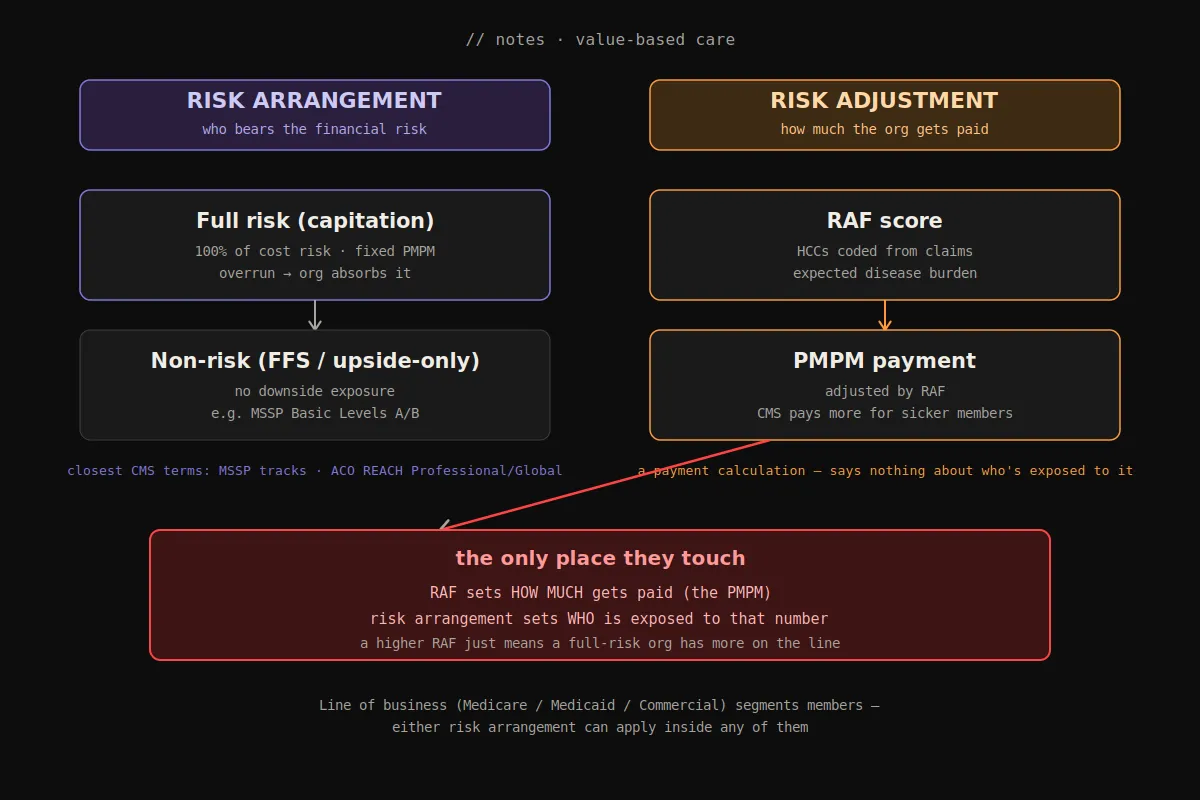
The connection between the two: RAF determines how much gets paid. The contract arrangement determines who’s on the hook for what happens to that payment. A full-risk org with a higher RAF score has a bigger number to manage risk against — but risk adjustment itself doesn’t touch who’s managing it.
Key takeaways
- Full risk / non-risk ≠ line of business. LOB segments members; risk arrangement segments who pays for surprises.
- CMS has no single “full risk / non-risk” regulatory category — ACO REACH’s Professional/Global split is the closest formal analog, alongside MSSP’s BASIC/ENHANCED tracks.
- Risk adjustment (RAF, HCCs — the layer Tuva’s risk-adjustment product is built around) and risk arrangement (full-risk vs non-risk) share a word and nothing else — one sets the payment, the other sets who’s exposed to it.
17 Sep 2026 · #valuebasedcare #healthcareanalytics #medicareadvantage #cms #tuva
GLB_